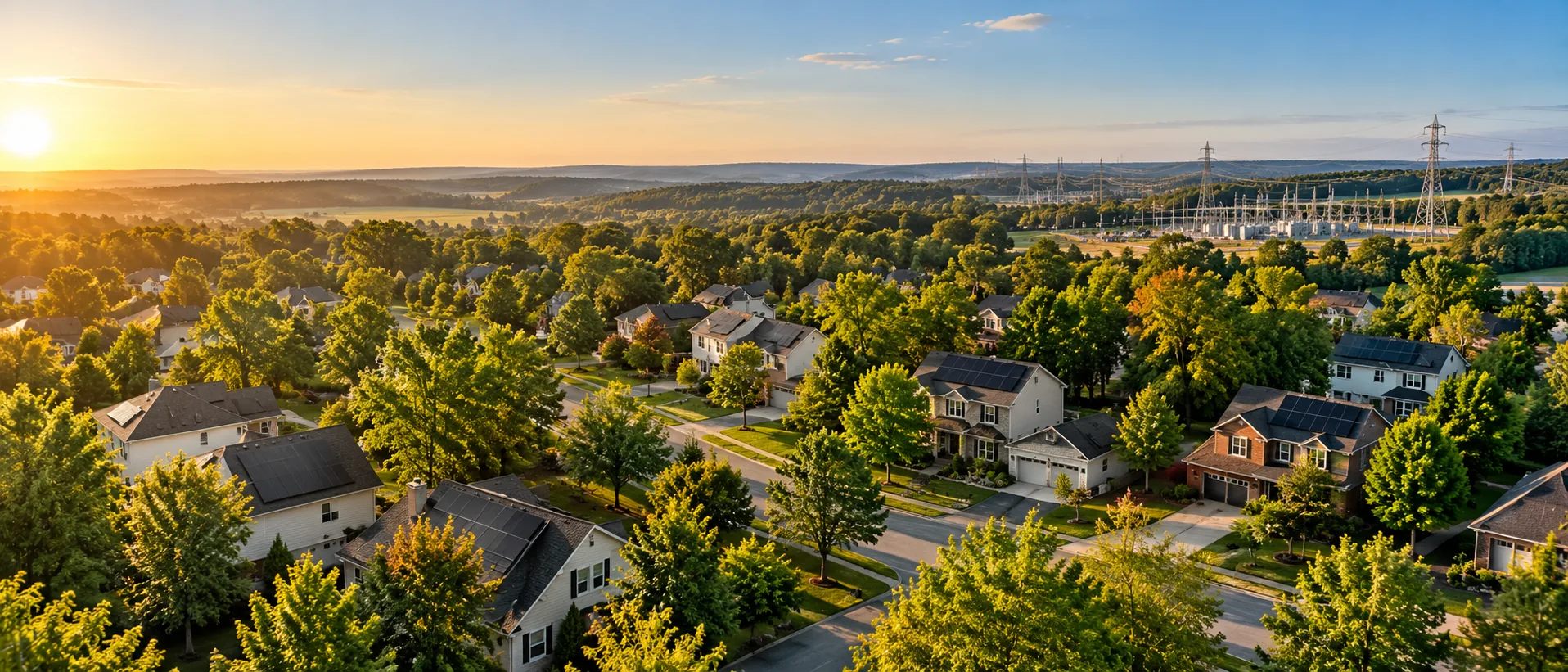

The Maryland Energy Administration’s (MEA) fiscal year 2026 commercial solar grant is closed; its budget is gone.1 The fiscal year 2027 grant, open until December 9, 2026, pays for solar only at nonprofits, local governments and schools.2,3 For-profit owners can still use commercial property assessed clean energy (C-PACE), a loan repaid on the property tax bill.4
Below are the Maryland grants and property-tax-based financing a commercial building owner can research before choosing a solar installer. Programs outside Maryland are not covered. Details are as of October 25, 2026, and funding and deadlines change, so check each administrator’s page before you commit.
The applicant for the grant is the organization whose building gets the upgrade. A rented building can use a signed letter from the property owner.3 For C-PACE, the applicant is the property owner, working with a lender.5
Is the Maryland commercial solar grant open for fiscal year 2027?
Not for most businesses. MEA’s fiscal year 2026 Commercial and Canopy Solar Program has no money left and its portal is closed.1 The fiscal year 2027 Commercial and Community Buildings Grant is open until 3:00 p.m. Eastern Time on December 9, 2026, but it funds solar for only three kinds of owner.2,3
| Program | Where it stands (October 25, 2026) | Source |
|---|---|---|
| MEA Commercial and Canopy Solar Program (fiscal year 2026) | Closed. Budget used up and portal closed | MEA program page1 |
| MEA Commercial and Community Buildings Grant (fiscal year 2027) | Open until December 9, 2026. Solar funding for nonprofits, local governments and school systems only | MEA program page and funding announcement2,6 |
| MEA energy storage rebate | Open until May 31, 2027, or sooner if funds are fully requested. You must reserve the rebate before installation | MEA program page7 |
| MEA Megawatts for Maryland | Closed-bid auction for large renewable and storage developers, not for an owner installing its own system. Application dates are on MEA’s page | MEA program page8 |
| Statewide C-PACE (Maryland Property Assessed Clean Energy, MDPACE) | Operating under program guidelines version 2.1, April 2026 | Program guidelines9 |
| Montgomery County C-PACE | Run by the Montgomery County Green Bank | County and Green Bank pages10,11 |
| Prince George’s County C-PACE | Offered through a county fund manager | Fund manager page12 |
| Federal Section 48E credit for solar | For solar facilities whose construction begins after July 4, 2026, the statute ends the credit for property placed in service after December 31, 2027 | Internal Revenue Service (IRS) Form 3468 instructions and statute13 |
MEA’s May 2026 notice of upcoming programs also lists a Community Solar Grant Program for community solar subscriber organizations and a SolarAPP+ grant for permitting authorities. Neither is aimed at an owner installing solar for its own use.14
Who can get solar money from the fiscal year 2027 grant?
Only nonprofits, local governments and local education agencies (LEAs, meaning public school systems) can apply for solar funding in this program.3 A for-profit commercial owner can apply to the same program for electrification and efficiency work, but not for solar panels.15
| Applicant | Solar funding | Rooftop or ground-mount rate, direct ownership | Rooftop or ground-mount rate, third-party owned | Canopy rates | Project cost cap |
|---|---|---|---|---|---|
| For-profit commercial building | Not eligible | None | None | None | Not applicable |
| Nonprofit | Eligible | $3,000 per kilowatt of direct current (DC) | $600 per kilowatt DC | $3,500 direct; $750 third-party owned | 65 percent6 |
| Local government | Eligible | $3,000 per kilowatt DC | $600 per kilowatt DC | $3,500 direct; $750 third-party owned | 80 percent6 |
| School system (LEA) | Eligible | $3,000 per kilowatt DC | $600 per kilowatt DC | $3,500 direct; $750 third-party owned | 90 percent6 |
The rates and caps come from MEA’s funding announcement, modified September 28, 2026. Nonprofit projects at State or Montgomery County Building Energy Performance Standards (BEPS) buildings earn an added $50 per kilowatt, and school projects at qualifying sites get a separate $50 bonus.6 Each solar award has a minimum of $50,000 and a maximum of $1,000,000,6 and MEA can award partial grants when its budget runs short.6
A third-party-owned system has to be net metered to qualify.6 Maryland law says the Public Service Commission must require electric utilities to offer a standard net metering contract or tariff, first come, first served, until the earlier of the date eligible customer-generators reach 3,000 megawatts statewide or July 1, 2027.16 If your project depends on net metering, find out where the cutoff stands before you set a construction schedule. Our net metering deadline guide covers it.
One trap to avoid: a nonprofit developer can’t apply on behalf of a for-profit business that wants a power purchase agreement (PPA) system on its roof. MEA says the applicant and the awardee must be the organization whose building is being upgraded.3 MEA also bars more than one MEA incentive for the same project scope at the same location.6
Illustrative example, not a quote and not a Soleil project. Assumptions: a nonprofit-owned 100-kilowatt DC rooftop array, using the published per-kilowatt rates for nonprofit solar as of October 2026. The result ignores the project-cost cap, the minimum, the maximum, the bonuses and MEA’s scoring. The cap can lower either figure. Under direct ownership the formula gives $300,000. Under third-party ownership it gives $60,000, one fifth of the direct-ownership figure.17 For a 100-kilowatt DC canopy over a parking lot, the formula gives $350,000 for direct ownership and $75,000 for third-party ownership.17
Who owns the system changes the result sharply. Direct ownership pays five times the third-party figure on a rooftop or ground-mount array and about 4.7 times on a canopy. If your organization qualifies, have each installer price the system both ways before you choose.
How does the grant pay out?
The grant reimburses work after it’s done. MEA says funds are disbursed as reimbursements in arrears, and costs incurred before the grant agreement takes effect aren’t reimbursed unless MEA agrees in writing. Applicants cover project costs up front, then submit invoices.6,3
The dates that matter:
- Applications close: 3:00 p.m. Eastern Time, December 9, 2026.2
- Award or non-award notice: anticipated spring 2027.6
- Work period: existing-building projects finish within about 36 to 48 months of an executed grant agreement.6
- Budget: MEA anticipates $103,949,085 across five tracks, including $48,049,085 for commercial buildings and $18,000,000 for local governments.2
A solar application needs more than a quote. The funding announcement calls for site evaluations, solar potential assessments and preliminary engineering studies, plus a one-line electrical diagram, a construction schedule, and output from a reputable solar calculator such as PVWatts.6 MEA says the solar company can supply the preliminary engineering studies.3 You also provide 12 months of utility bills, and nonprofits add an IRS letter confirming tax-exempt status, or alternative documentation MEA reviews case by case.6
MEA warns that Maryland grants may be taxable and may trigger a Form 1099-G, and it says tax questions belong with a qualified tax professional.6 The cost caps apply to total project cost including other funds, so you must list every other incentive or funding source.3,6
What can a for-profit business still use for solar?
MEA’s published fiscal year 2027 programs include no solar grant for a for-profit owner’s own roof.14,3 You still have options. Three routes remain, each with its own limits, and a fourth exists in Montgomery County. Which one fits depends on your county and your tax position.
- C-PACE financing can pay for solar on private and nonprofit property. The sections below explain how.4,18
- The MEA storage rebate pays for batteries. Commercial organizations can apply until May 31, 2027, or until funds run out, and must reserve the rebate before installing.7 Our commercial battery storage guide goes deeper.
- The federal credit has a clock, covered below. Your tax position is a question for your adviser. The commercial solar tax credit deadline guide lays out the timing rules.
The fourth path is local. The Montgomery County Green Bank lists a commercial solar power purchase agreement program for systems of at least 25 kilowatts, third-party owned and maintained, at a fixed price per kilowatt-hour with no out-of-pocket cost.11
Megawatts for Maryland sounds relevant but serves a narrower audience. It’s a closed-bid auction for developers of large renewable generation that doesn’t use net metering, plus storage.8 MEA posts its funding announcement and application stages on the program page, so check there for current status.
How does C-PACE work?
C-PACE is a loan from a private lender that the owner repays as a surcharge on the county property tax bill. Maryland’s Local Government Article lets a county or municipality set up such a program, and the loan can finance renewable energy projects for commercial property owners. It’s a loan, so it adds debt.4
The loan stays with the property. State law says a buyer of a property with the surcharge assumes the obligation to pay it, and an unpaid surcharge is a lien on the real property.4 The statewide guidelines describe the surcharge as having the senior lien status of a real property tax assessment, and say the loan cannot be accelerated.9 The statute lets the county collect the surcharge this way with the express consent of any mortgage or deed of trust holder, and the program guidelines require that consent in writing.4,5
Solar is an approved use. The guidelines list solar photovoltaic power and solar battery storage as renewable energy improvements.18 An MDPACE case study of a former printing facility in Baltimore County, converted to self-storage, lists solar among the improvements in a $3 million, 20-year financing.19 It doesn’t break out the solar cost.19
| MDPACE term | What the guidelines say (version 2.1, April 2026) |
|---|---|
| Minimum loan | $50,00020 |
| Combined loan-to-value | The C-PACE loan plus existing mortgages can’t exceed 100 percent of assessed or market value, whichever is greater, except by case-by-case exception20 |
| Term | Can’t exceed the weighted average useful life of the improvements, capped at 35 years with case-by-case exceptions20 |
| Application fee | None21 |
| Closing fee | 1.05 percent of the surcharge amount (fees can change)21 |
| Annual servicing fee | 1.5 percent of the annual surcharge amount, with a minimum of $300 and a maximum of $2,000 (fees can change)21 |
| County fees | Vary by county21 |
Some counties charge their own application, recording and annual fees.21 The Maryland Clean Buildings Hub, part of MEA, says C-PACE terms are typically 10 to 20 years.22
Qualifying property includes office, industrial, retail, hospitality, healthcare, agricultural and multifamily buildings with more than four dwelling units. Nonprofits qualify if they have a property tax identification number. The program doesn’t authorize a surcharge on government-owned property, with limited ground-lease exceptions.23
Which Maryland counties offer C-PACE?
Only counties that have opted in. The Maryland Clean Buildings Hub reports that 19 Maryland counties have passed enabling legislation.22 A county must adopt an ordinance and sign a locality agreement with the Maryland Clean Energy Center (MCEC) to join MDPACE.24
- Howard County is on MCEC’s list of participating MDPACE counties.24
- Montgomery County runs its program separately through the Montgomery County Green Bank, selected in early 2021.10,24
- Prince George’s County also runs separately, through a county fund manager.24,12
- MCEC’s participating-localities list shows 17 jurisdictions, including Baltimore City. MCEC has administered the program directly since September 2025.25,24
MCEC says counties are still adopting amended ordinances for the updated program, and existing transactions can continue under the earlier guidelines until a county adopts the update.24 Confirm with your county that its ordinance matches version 2.1.
Terms differ by county. The Montgomery County Green Bank lists C-PACE financing of up to 100 percent upfront with a 20-year term, covering solar and storage, and says it isn’t suitable for condominiums.11 FSC First, the fund manager for Prince George’s County, describes financing of up to 20 percent of the appraised value, with solar energy equipment among the eligible measures.12 Because that figure differs from the statewide and Montgomery terms, confirm it with the fund manager.
What are the steps to finance solar with C-PACE?
The owner starts with a short online pre-application, which the administrator typically reviews within one to two business days.5 After approval, the owner develops the project with a contractor, an independent third party, a lender and any existing mortgage holders. The guidelines lay out six steps.
- Pick a registered contractor. Every financed project must be installed by a business the program administrator has approved. Registration is a one-page form, and it doesn’t check a contractor’s competence or license status. Work that requires a license must still be done by a registered contractor who holds it. A contractor not yet registered can register before final approval.5
- Develop a project analysis. For solar, it covers expected production, site conditions, the site’s energy use, assumed savings, the utility rate that will apply, and confirmation that net metering is available for any power sent to the grid.5
- Hire an independent third party to check the analysis. The guidelines require an approved party who isn’t engaged in the project.5
- Get a lender’s offer. The owner must show that a capital provider has offered to finance the project, and may pre-select its lender.5
- Request mortgage holder consent. The guidelines suggest sending requests well ahead of closing, for example 30 days.5
- Submit the final application, close and build. The lender records the lien documents, and the administrator then notifies the county to start billing the surcharge.5
Which costs do the grant and C-PACE each cover?
The two overlap on equipment but differ on soft costs, timing and who can use them. The grant column applies only to the three owner types that can seek solar funding. The C-PACE column reflects statewide MDPACE rules, so a county may differ.
| Cost or feature | Fiscal year 2027 MEA grant | C-PACE under MDPACE |
|---|---|---|
| Solar equipment and installation | Eligible for rooftop, ground-mount and canopy solar, for nonprofits, local governments and LEAs6 | Hard costs and solar photovoltaic improvements are eligible18 |
| Engineering and design | Eligible when listed as a line item3 | Architectural and engineering costs are soft costs18 |
| Roof work | Roof upgrades can be included alongside rooftop solar, but a full roof replacement isn’t an eligible measure3 | Roof structural work needed to support a roof-mounted array counts as an ancillary cost18 |
| Feasibility studies | Ineligible15 | Consulting reports, including feasibility studies, are soft costs18 |
| Planning and analysis | Pre-implementation costs eligible for nonprofits, LEAs and local governments, up to 15 percent of the grant6 | Included in soft costs18 |
| Legal, title, appraisal and lender fees | Not among the listed eligible activities15 | Listed soft costs, including closing fees, legal services and appraisals18 |
| Batteries | Eligible only under the community resilience track, and must connect to solar3 | Solar battery storage and energy storage are listed18 |
| When money flows | Reimbursement after work and invoices6 | Proceeds are disbursed under the financing agreement between lender and owner5 |
| Repayment | Not a loan, though the grant may be taxable6 | Repaid through the property tax bill over the term4 |
| Who can use it | Solar: nonprofits, local governments, LEAs3 | Private and nonprofit property owners; government-owned property is generally excluded23 |
Which solar funding route fits your owner type?
Your owner type decides which tools exist. A for-profit business can use C-PACE but has no solar grant. A nonprofit can use both, as long as its property has a tax identification number. Local governments and school systems can seek the grant but generally can’t use C-PACE, because government-owned property is excluded.3,23
| Owner type | Solar grant (fiscal year 2027) | C-PACE | Federal credit route |
|---|---|---|---|
| For-profit business | No | Yes, where the county participates23 | Credit transfer to a buyer may be possible; confirm with a tax professional26 |
| Nonprofit | Yes, competitive3 | Yes, if the property has a tax identification number23 | Elective pay may be available after IRS registration26 |
| Local government | Yes, competitive3 | Generally no, because government-owned property is excluded23 | Elective pay may be available after IRS registration26 |
| School system | Yes, competitive3 | Generally no, for the same reason23 | Elective pay may be available after IRS registration26 |
Can you stack the grant, C-PACE and the federal credit?
The three can share a project budget, but each has its own rules. The C-PACE guidelines encourage owners to pursue all applicable government, utility and manufacturer rebates.5 MEA’s grant tells applicants to list every other funding source and applies its caps to total project cost.3,6 MEA also points applicants who need bridge loans to the Maryland Clean Energy Center.3
The federal piece is a calendar problem. Under the Section 48E statute, the credit does not apply to solar property placed in service after December 31, 2027 when the facility’s construction begins after July 4, 2026. The IRS says the same in its Form 3468 instructions.13 A facility whose construction began on or before July 4, 2026 isn’t covered by that cutoff.
The IRS instructions name two ways to show that construction has begun: the physical work test and the 5 percent safe harbor.13 IRS Notice 2025-42 had limited the 5 percent safe harbor for solar to projects of 1.5 megawatts alternating current (AC) or less.27 A federal district court vacated that notice on June 6, 2026.27 As of October 25, 2026, the court’s public docket shows no later filing, but an appeal or new IRS guidance would change the picture, so ask your tax adviser which rules apply to your start date.27
The IRS has also said taxpayers may rely on a safe harbor under which a facility placed in service no more than four calendar years after the calendar year construction began is treated as meeting the continuity requirement.28
Now set that beside the grant. MEA expects award notices in spring 2027, and its grant reimburses only costs after the agreement takes effect unless MEA agrees otherwise in writing.6 Grant-funded existing-building projects can run 36 to 48 months, well past the end of 2027.6 Net metering for a new system can close to new customers by July 1, 2027.16 A tax-exempt owner using elective pay must register with the IRS before filing.26
Whether grant money reduces eligible basis, how a PACE-financed system is treated, and whether a project counts as an earlier construction start are questions for a tax adviser. For what a commercial build costs, see our commercial solar installation cost guide.
What should you do before December 9?
Start with your owner type, then work backward from the December 9, 2026 deadline. The grant is competitive, and the application needs engineering documents, utility bills and, for nonprofits, a tax-exempt letter.6 Put the long-lead items first, and check each against the checklist below.
- Confirm your owner type and building type against the tables above.
- Check your county’s C-PACE status with MCEC, the Montgomery County Green Bank or the Prince George’s fund manager.24
- If you’re a nonprofit, local government or school system, gather 12 months of utility bills, the IRS letter where required, and a preliminary solar design.6
- Get each installer to price direct ownership and third-party ownership side by side.
- Raise mortgage holder consent with your lender early, since the guidelines suggest roughly 30 days of lead time.5
- Take the grant’s tax form and the credit timing to a tax adviser.6
MEA also holds virtual office hours for the grant through December 3, 2026. The dates and registration link are on the program page.2
Soleil Energy designs, engineers, sources and builds solar for homes, businesses and utilities. Its utility-scale and commercial solar page describes the engineering, procurement, construction and interconnection scope. Program rules decide who qualifies, and a C-PACE project must use a contractor the program administrator has approved, so ask any installer whether it is registered with the program administrator.5
What falls outside this guide?
Several limits apply to everything above, and each one is worth confirming with the program administrator or your tax adviser before you commit money or sign a contract. The list below covers the main ones, starting with the places this guide does not reach.
- District of Columbia and Virginia programs are not covered.
- If the statute or a county ordinance conflicts with the MDPACE guidelines, the law controls, as the guidelines themselves say.9
- MEA’s general notice says program names and details may change, so recheck before you rely on a launch date.14
- A grant formula result isn’t an award. MEA scores applications, may fund partially, and applies the caps.6
- Eligibility for the federal credit, including the construction-start date, is a tax question for your adviser.
For a commercial solar scope discussion, request a proposal or call (301) 953-4140.
Solar savings and incentive eligibility depend on your roof, your usage, your utility, and your tax situation. Incentive programs change and some have limited funding. We are not tax advisors — we will review your bill with you and tell you what you may qualify for. Confirm any tax credit with a qualified tax professional.
Program rules decide who qualifies. Ask any installer whether it is on the program’s contractor list.
Sources (28)
-
Maryland Energy Administration (MEA), Commercial and Canopy Solar Program. https://energy.maryland.gov/business/Pages/Commercial-Solar.aspx . Current page, read October 25, 2026; budget table last updated April 21, 2026. ↩ ↩2 ↩3
-
MEA, Commercial and Community Buildings Grant Program (fiscal year 2027). https://energy.maryland.gov/Pages/Commercial%26CommunityBuildingsGrantProgram.aspx . Launch date September 9, 2026; current page, read October 25, 2026. ↩ ↩2 ↩3 ↩4 ↩5 ↩6
-
MEA, Commercial and Community Buildings Grant Program fiscal year 2027 Frequently Asked Questions, updated October 19, 2026. https://energy.maryland.gov/SiteAssets/Pages/Commercial%26CommunityBuildingsGrantProgram/FY27%20CCB%20Program%20-%20Frequently%20Asked%20Questions_v3101926.pdf . Read October 25, 2026. ↩ ↩2 ↩3 ↩4 ↩5 ↩6 ↩7 ↩8 ↩9 ↩10 ↩11 ↩12 ↩13 ↩14 ↩15 ↩16 ↩17 ↩18 ↩19
-
Maryland General Assembly, Annotated Code of Maryland, Local Government Article, sections 1-1102, 1-1103 and 1-1105. https://mgaleg.maryland.gov/mgawebsite/Laws/StatuteText?article=glg§ion=1-1105&enactments=false . Current statute text, read October 25, 2026. ↩ ↩2 ↩3 ↩4 ↩5 ↩6
-
Same source as 9, sections 3.4.5, 3.8, 3.9, 3.10, 4.2.1, 4.2.2, 6.1, 6.2, 6.3 and 6.4. ↩ ↩2 ↩3 ↩4 ↩5 ↩6 ↩7 ↩8 ↩9 ↩10 ↩11 ↩12 ↩13
-
MEA, Fiscal Year 2027 Commercial and Community Buildings Funding Opportunity Announcement, issued September 9, 2026, modified September 28, 2026. https://energy.maryland.gov/SiteAssets/Pages/Commercial%26CommunityBuildingsGrantProgram/FY27%20CCB%20Grant%20Program_MEA_FOA_Final%20092826%20v3.pdf . Read October 25, 2026. ↩ ↩2 ↩3 ↩4 ↩5 ↩6 ↩7 ↩8 ↩9 ↩10 ↩11 ↩12 ↩13 ↩14 ↩15 ↩16 ↩17 ↩18 ↩19 ↩20 ↩21 ↩22 ↩23 ↩24 ↩25 ↩26 ↩27 ↩28
-
MEA, Residential and Commercial Energy Storage Grant Program. https://energy.maryland.gov/Pages/Energy-Storage-Grant-Program.aspx . Fiscal year 2027 program page, current page, read October 25, 2026. ↩ ↩2
-
MEA, Megawatts for Maryland. https://energy.maryland.gov/Pages/MegawattsForMaryland.aspx . Notice of intent for fiscal years 2027 and 2028, current page, read October 25, 2026. ↩ ↩2
-
Maryland Clean Energy Center (MCEC), MDPACE Program Guidelines, version 2.1, April 2026, executive summary and sections 7.1 and Disclaimers. https://www.mdcleanenergy.org/wp-content/uploads/2026/04/MDPACE_ProgramGuidelines_REV.pdf . Read October 25, 2026. ↩ ↩2 ↩3 ↩4 ↩5 ↩6 ↩7 ↩8
-
Montgomery County, Department of Environmental Protection, Commercial PACE Financing, and Department of Finance, Commercial PACE. https://www.montgomerycountymd.gov/department-environmental-protection/energy/energy-commercial-multifamily/commercial-pace-financing and https://www.montgomerycountymd.gov/department-finance/fiscal-management-program/fiscal-management-projects/commercial-pace-property-assessed-clean-energy . Current pages, read October 25, 2026. ↩ ↩2
-
Montgomery County Green Bank, Commercial Programs (MC-PACER and commercial solar power purchase agreement). https://mcgreenbank.org/commercial-programs/ . Page modified May 25, 2026; read October 25, 2026. ↩ ↩2 ↩3
-
FSC First, Commercial Property Assessment for Clean Energy. https://fscfirst.com/learn/programs/commercial-property-assessment-for-clean-energy/ . Current page, read October 25, 2026. ↩ ↩2 ↩3
-
Internal Revenue Service, Instructions for Form 3468 (2025), https://www.irs.gov/instructions/i3468 ; Public Law 119-21, section 70513(g)(5), https://www.congress.gov/119/plaws/publ21/PLAW-119publ21.htm ; and 26 USC 48E(e)(4), https://www.law.cornell.edu/uscode/text/26/48E . Public Law dated July 4, 2025; Form 3468 instructions page last reviewed August 28, 2026; instructions and statute read October 25, 2026. ↩ ↩2 ↩3
-
MEA, General Notice of Intent for Upcoming Fiscal Year 2027 Energy Programs, last modified May 20, 2026. https://energy.maryland.gov/SiteAssets/Pages/all-incentives/ACCESSIBLE%20FY27%20General%20Notice%20of%20Upcoming%20Programs.pdf , listed on https://energy.maryland.gov/Pages/all-incentives.aspx . Read October 25, 2026. ↩ ↩2 ↩3
-
MEA, Commercial and Community Buildings Grant Program, Commercial Buildings Track 1 sector guide, updated September 29, 2026. https://energy.maryland.gov/SiteAssets/Pages/Commercial%26CommunityBuildingsGrantProgram/FY27%20CCB%20Program%20-%20Commercial%20Specific%20Details%20v3%20092926.pdf . Read October 25, 2026. ↩ ↩2 ↩3
-
Maryland General Assembly, Chapter 353 (House Bill 1532, Utility RELIEF Act of 2026), Public Utilities Article section 7-306(d)(1). https://mgaleg.maryland.gov/2026RS/chapters_noln/Ch_353_hb1532E.pdf . Approved May 12, 2026; read October 25, 2026. ↩ ↩2
-
Illustrative calculation, run October 2026, with the inputs sourced at 6. ↩ ↩2
-
Same source as 9, sections 3.5 and 3.6 and Appendix B. ↩ ↩2 ↩3 ↩4 ↩5 ↩6 ↩7 ↩8 ↩9
-
MCEC, MDPACE case studies, Pikesville Self-Storage. https://www.mdcleanenergy.org/mdpace-case-studies/ . Current page, read October 25, 2026. ↩ ↩2
-
Same source as 9, sections 3.4.3.2, 3.4.3.3 and 3.4.3.5. ↩ ↩2 ↩3
-
Same source as 9, sections 5.1, 5.2 and Appendix C. ↩ ↩2 ↩3 ↩4 ↩5
-
MEA Maryland Clean Buildings Hub, Commercial Property Assessed Clean Energy (C-PACE). https://energy.maryland.gov/business/pages/cpace-financing-resources.aspx . Current page, read October 25, 2026. ↩ ↩2
-
MCEC, MDPACE Participating Localities, https://www.mdcleanenergy.org/programs/participating-localities/ ; and About PACE, https://www.mdcleanenergy.org/programs/about-pace/ . Current pages, read October 25, 2026. ↩ ↩2 ↩3 ↩4 ↩5 ↩6 ↩7
-
MCEC, MCEC Assumes Leadership of C-PACE Program. https://www.mdcleanenergy.org/news/mcec-assumes-leadership-of-c-pace-program/ . News item dated December 2, 2025; read October 25, 2026. ↩
-
Internal Revenue Service, Instructions for Form 3468 (2025), pre-filing registration, https://www.irs.gov/instructions/i3468 ; and Elective pay and transferability, https://www.irs.gov/credits-deductions/elective-pay-and-transferability . IRS page last reviewed June 27, 2026; read October 25, 2026. ↩ ↩2 ↩3 ↩4 ↩5
-
U.S. District Court for the District of Columbia, Oregon Environmental Council v. Internal Revenue Service, No. 1:25-cv-04400, Memorandum Opinion (Document 50), describing Notice 2025-42 and vacating it. https://storage.courtlistener.com/recap/gov.uscourts.dcd.287847/gov.uscourts.dcd.287847.50.0.pdf . Dated June 6, 2026; read October 25, 2026. Docket status checked October 25, 2026 at https://www.courtlistener.com/docket/72054098/oregon-environmental-council-v-internal-revenue-service/ : terminated June 8, 2026; last known filing June 6, 2026 (public RECAP coverage can be incomplete). ↩ ↩2 ↩3
-
Internal Revenue Service, Internal Revenue Bulletin 2024-34, preamble to T.D. 9998 (continuity safe harbor for sections 30C, 45V, 45Y and 48E). https://www.irs.gov/irb/2024-34_IRB . Published August 19, 2024; read October 25, 2026. ↩